
AI/ML
Google’s Gemini Triples Generative AI Market Share to 18% Challenging ChatGPT’s Dominance in 2025
This is the clearest signal that Alphabet is winning the AI war

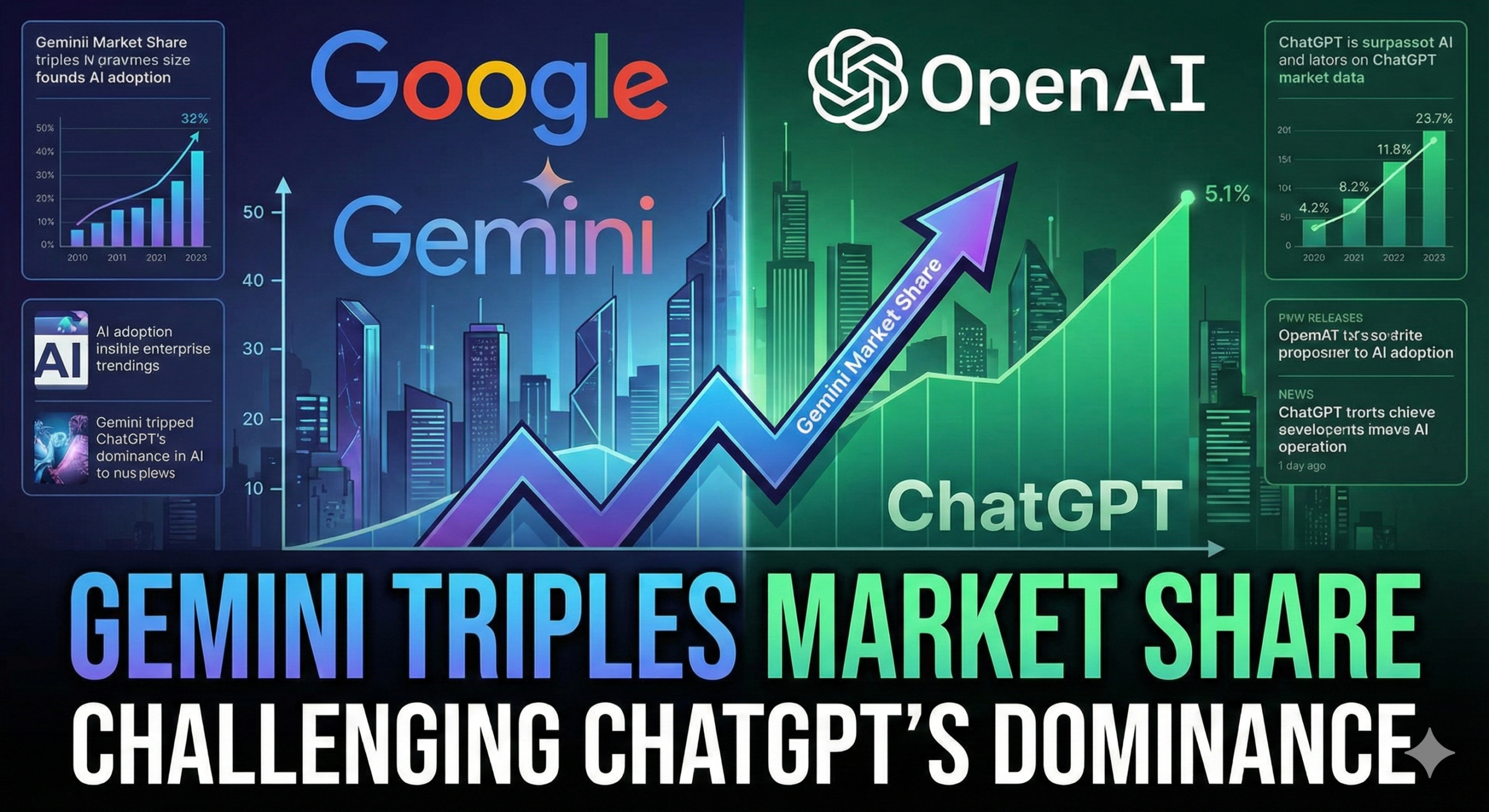
Google’s Gemini AI has surged from 5.4% to 18.2% in generative AI web traffic share over the past year, according to Similarweb data, while ChatGPT’s lead has eroded from 87.2% to 68%. This rapid growth positions Gemini as a serious contender in the AI race, driven by strategic integrations across Google’s ecosystem.
Key Growth Drivers
Gemini’s rise stems from seamless embedding into everyday tools like Chrome, Android, Google Search, Docs, and Gmail, exposing billions of users without requiring separate app downloads. Features such as AI Overviews now reach 2 billion users monthly across 200 countries, boosting daily active users to 35 million by early 2025. Viral innovations like the Nano Banana image editor have further accelerated adoption, displacing ChatGPT as the top free iOS app at times.
Market Impact
ChatGPT’s decline reflects a maturing AI landscape where first-mover advantage fades against competitors with superior distribution. Alphabet’s stock has outperformed broader markets this year, signaling investor confidence in Gemini’s momentum. Globally, Gemini commands 24% market share among LLM tools, leading in regions like Europe (29% penetration) and India.
Competitive Landscape
| AI Platform | Current Traffic Share | YoY Change | Monthly Users (Recent) |
|---|---|---|---|
| ChatGPT | 68% | -19.2 pts | ~1B visits |
| Gemini | 18.2% | +12.8 pts | 450M-650M active |
| Copilot | ~1.2% | Stagnant | N/A |
| Others | ~12.6% | Varies | N/A |
Data compiled from Similarweb trends; Gemini’s native integration gives it an edge over standalone rivals.
Future Outlook
Gemini’s multimodal capabilities (text, images, audio, video in 46 languages) and enterprise Workspace integrations (2.3B document interactions in H1 2025) suggest sustained growth. As AI shifts to routine utility, Google’s ecosystem dominance could redefine user interactions beyond chatbots. HOI News will monitor updates as the 2026 AI battle intensifies.

Major Restructuring at xAI Sparks Co-Founder Exodus
Estimated Reading Time: 5 minutes
Key Takeaways
- Elon Musk’s xAI restructured, leading to the exit of six co-founders and over ten engineers.
- Notable departures include co-founders Tony Wu and Jimmy Ba.
- Musk reorganized xAI into four main product teams focused on AI efficiency.
- The restructuring raises questions about the company’s organizational stability and innovation potential.
- Upcoming products such as the standalone XChat app and X Money are anticipated.
Context / Background
xAI was founded by Musk to focus on advanced AI technologies. Following its recent merger with SpaceX, the company took steps aimed at enhancing productivity and ensuring that it could keep pace with the rapidly evolving AI landscape. The restructuring was officially announced just days before an all-hands meeting held on February 10, 2026, which marked the first such meeting since the merger.
Key Details
The wave of departures included prominent figures such as Tony Wu, who announced his resignation via X on February 9, stating it was “time for my next chapter.” Co-founder Jimmy Ba followed suit during the all-hands meeting, where he thanked Musk and made a bold prediction of achieving “100x productivity” in AI within a year. Other co-founders who exited included Hang Gao, Roland Gavrilescu, and Chace Lee, with plans to start new AI ventures comprising smaller teams.
This restructuring resulted in a dramatic reduction of xAI’s founding team, with only six of the original twelve members remaining. Additionally, more than ten engineers publicly departed in the same week, further indicating a shift within the company. Despite these exits, xAI retains more than 1,000 employees and continues to hire aggressively, signaling an important push for growth.
In terms of organizational changes, Musk reorganized xAI into four primary product teams: Grok, Grok Voice, Grok Code, and Grok Imagine, along with a team focused on Macrohard, which aims to automate white-collar work utilizing Grok-powered multi-agent systems. Musk emphasized that these changes were necessary to improve the speed of execution as the company evolves. He stated that some individuals were “better suited for early stages” of development and less so for later stages, which justified the need to “part ways” with specific team members.
Impact
The departures could have ramifications for xAI’s capabilities and innovation, especially given the ongoing competition with AI leaders such as OpenAI, Anthropic, and Google. The restructuring has triggered discussions about employee retention in an industry rife with rapid advances and significant talent poaching.
Furthermore, the controversy surrounding xAI is compounded by ongoing regulatory scrutiny. Notably, French authorities raided X offices in relation to concerns over the potential misuse of Grok technologies, particularly in generating non-consensual deepfakes, which could reflect deeper issues regarding ethical AI deployment and corporate governance.
For users and stakeholders, the rapid changes signal an early push towards a more structured product development path at xAI. However, it raises questions about organizational stability and the firm’s ability to innovate amid the exits of experienced personnel.
What’s Next
As xAI forges ahead, the company is poised for significant developments, especially with Musk’s ambitious visions laid out during the all-hands meeting. These include the forthcoming standalone XChat app for messaging and video communication, along with X Money, an application designed for global financial transactions that is currently in a closed beta phase. With the anticipated IPO in 2026, the structural changes could ultimately play a crucial role in how well xAI responds to market demands and regulatory challenges in the coming years.
FAQ Section
What happened to the xAI co-founders?
Six out of the twelve original co-founders left xAI due to a significant restructuring aimed at improving efficiency after the company’s merger with SpaceX.
Who are the departed co-founders?
The departed co-founders include Tony Wu, Jimmy Ba, Hang Gao, Roland Gavrilescu, and Chace Lee.
Why did they leave?
They expressed the need for new ventures and aspirations, and Musk indicated that some were better suited for earlier stages of development.
What are the organizational changes at xAI?
xAI has been reorganized into four primary product teams: Grok, Grok Voice, Grok Code, and Grok Imagine, along with a focus on Macrohard for automating white-collar work.
How will this affect xAI?
The restructuring could impact xAI’s innovation capabilities and its ability to retain talent amidst fierce competition in the AI industry.

India to Push for Global AI Commons at AI Impact Summit in New Delhi
- India aims to establish a “global AI commons” at the AI Impact Summit on February 19-20, 2026.
- Focus on AI’s potential to drive social impact in health, education, and agriculture.
- Collaboration among nations to share resources and technologies rather than just purchasing them is emphasized.
- 12 projects are currently funded to enhance India’s AI capabilities.
- The summit will guide discussions around global collaboration in AI technologies.
Main Content
Context / Background
Key Details
Impact
What’s Next
FAQ Section
What is the AI Impact Summit?
When will the AI Impact Summit take place?
What is the goal of establishing a “global AI commons”?
What role does India aim to play in AI advancements?
AI/ML
Adobe unveils Firefly Foundry to build IP-safe generative AI models for studios
Adobe unveils Firefly Foundry to build IP-safe generative AI models for studios

Adobe is expanding its Firefly AI ecosystem with a new offering called Firefly Foundry, pitched as a way for entertainment and media companies to use generative AI without risking third-party intellectual property violations. Timed with this year’s Sundance Film Festival, the initiative focuses on “private, IP-safe” omni-models built and trained specifically for individual clients such as studios, streamers, and talent agencies. (The Verge, Jan 22, 2026)theverge+1
Firefly Foundry differs from many mainstream generative AI models by restricting its training data to content that the client already owns or has rights to use. Instead of drawing on massive internet-scale datasets, Adobe’s engineers work with partners to build bespoke models that learn from studio libraries, brand assets, and franchise materials under clear licensing controls. The company says this approach is meant to enhance creative workflows while protecting ownership and artistic intent across the production pipeline. (The Verge, Jan 22, 2026)business.adobe+1
“This approach is meant to enhance creative workflows while protecting ownership and artistic intent across the production pipeline.”
The new models are designed to support a range of production tasks, from early concepting to final post-production. Adobe highlights use cases such as generating audio-aware video clips, 3D elements, and vector graphics that can drop into existing timelines and project files in applications like Premiere Pro and other Creative Cloud tools. By keeping everything inside a controlled, rights-cleared environment, studios gain the speed and flexibility of generative AI while maintaining stricter guardrails on how their IP is used and extended. (The Verge, Jan 22, 2026)letsdatascience+1
Firefly Foundry grew out of previous enterprise engagements where Adobe offered less customizable Firefly models trained on licensed stock and public domain material. Those earlier systems could reliably produce static images but struggled to reflect the visual language and narrative worlds of specific franchises. Executives say clients increasingly asked for models that truly understood their universes and characters, leading Adobe to develop a service that can be tuned deeply on proprietary catalogs while still following its established principles around responsible AI. (The Verge, Jan 22, 2026)theverge+1
For Hollywood, where legal exposure and brand control are constant concerns, the promise of IP-safe AI arrives at a sensitive moment. Recent industry labor disputes and ongoing debates over synthetic performers, AI-written scripts, and digital doubles have sharpened scrutiny of how training data is sourced and how credits and compensation are handled. By framing Firefly Foundry as a tool that stays within the boundaries of owned IP, Adobe is signaling that studios can modernize their pipelines without crossing current legal and ethical red lines. (The Verge, Jan 22, 2026)letsdatascience+1
Hannah Elsakr, Adobe’s vice president of generative AI new business ventures, has positioned the service as a natural step for large media companies already reliant on Adobe tools. She notes that enterprises have been asking Adobe not just for AI features, but for partnership on governance, safety, and long-term integration of generative systems into creative work. With Firefly Foundry, Adobe is betting that its track record with Photoshop, Premiere Pro, and other staples will help it become a default AI partner for the entertainment industry’s next phase of digital production. (The Verge, Jan 22, 2026)techzine+1
The move also reinforces Adobe’s broader strategy around content provenance and accountability. Previous Firefly products incorporated content credentials to document how AI-generated media was created, a feature that can support both transparency for audiences and auditability for rights holders. Extending that philosophy into customized, IP-bound models may give studios a clearer chain of custody for AI-assisted assets, an attractive prospect as regulators and industry bodies continue to refine standards around synthetic content. (The Verge, Sept 13, 2023; Jan 22, 2026)theverge+1
Looking ahead, Firefly Foundry positions Adobe in direct competition with newer AI startups offering tailored models for brands and media clients. However, Adobe’s deep integration with existing post-production and design workflows could prove a significant advantage, allowing editors, VFX teams, and marketers to experiment with generative tools inside familiar environments. If the service delivers on its IP-safe promise, it may help reshape how films, series, and campaigns are developed, with generative AI embedded across every stage but still operating within carefully negotiated rights frameworks. (The Verge, Jan 22, 2026)forbes+1
- Why it_Matters :
- Offers studios a way to deploy generative AI trained only on rights-owned assets, potentially lowering legal risk around IP use.business.adobe+1
- Integrates with Adobe’s existing creative suite, making AI-assisted production easier to adopt for established teams and workflows.theverge+1
- Aligns with growing demands for provenance, transparency, and responsible AI in synthetic media and entertainment content.computerworld+1


xAI Restructuring Leads to Major Co-Founder Departures

India Pursues Global AI Commons at Summit in New Delhi

Broadcom and TSMC Shape AI Semiconductor Industry
-

 Entertainment10 months ago
Squid Game Season 3 Trailer Teases a Brutal Finale: Gi-hun Returns for One Last Game
-
Fashion9 years ago
These ’90s fashion trends are making a comeback in 2017
-
Business9 years ago
The 9 worst mistakes you can ever make at work
-

 Science6 months ago
Aryabhata: India’s First Satellite That Sparked a Space Revolution
-

 AI/ML2 months ago
Adobe unveils Firefly Foundry to build IP-safe generative AI models for studios
-
Fashion9 years ago
According to Dior Couture, this taboo fashion accessory is back
-

 Science10 months ago
Vera C. Rubin Observatory Unveils First-Ever 3,200-Megapixel Images
-
Sports9 years ago
Phillies’ Aaron Altherr makes mind-boggling barehanded play